President Milanović in Knin: We are not concerned by the verbal nonsense coming from across the Danube, but rather by the fact that Serbia is arming itself with the help of our allies
The President of the Republic and Commander in Chief of the Armed Forces of the Republic of Croatia, Zoran Milanović, took part today in Knin in the ceremonial commemoration of the Victory and Homeland Thanksgiving Day and Day of Croatian Defenders, as well as the 31st anniversary of the military and police operation “Oluja” [Storm].
We deliver the speech of the President of the Republic in full:
“Ladies and gentlemen,
Croatian defenders, families of Croatian defenders, both living, fallen, and missing, highest state officials, Mr. Speaker of Parliament, Mr. Prime Minister, and all other officials and representatives of public authorities, religious communities, everyone present here today, all Croatian people watching this today via television receivers or other media, or who will watch it, Croats around the world and Croats in Bosnia and Herzegovina, because this was a joint war of brothers-in-arms, inseparable from one another.
Happy Victory Day, happy Day of the Croatian Defenders, and happy Homeland Thanksgiving Day!
In 2012, we introduced the practice of having a defender address the gathering on behalf of the defenders at the beginning of the ceremony. It was then held on the main square in Knin. That practice continues to this day and is very good because it actually comes from the defenders and those who participated in those operations. From them, one can hear what happened most accurately, most credibly, and – with the passage of time – most dispassionately. All the rest of us – me probably for the tenth or eleventh time – are a supplement, and apart from the deep gratitude that I have repeated here and repeat sincerely and from the heart on every occasion to the defenders, all those who stood by them, and their families during the war, I will repeat it once again to those who survived and to those, unfortunately far too numerous, who did not: a huge, profound, and sincere human thank you!
I mentioned Bosnia and Herzegovina! In those years of war, the Croatian people in Bosnia and Herzegovina fought a joint war with the Croatian people in Croatia: unprovoked, imposed, difficult, unpromising in those years, without help, even without serious verbal help, let alone material help. The peace process and peace in Bosnia and Herzegovina, the so-called Dayton or Paris Peace Agreement, was signed after the intervention of the Croatian Army. And not an adventurous, unauthorized, and headstrong intervention, but an intervention agreed upon with American allies and friends, with some parts of the final operation carried out even against our will, at their insistence. That is a debt owed to Croatia. There would be no Dayton without the Croatian Army, without the Croatian Guards brigades and the Croatian Defence Council, and we would have none of this today. That is the simple truth. In politics and history – and the Speaker of Parliament spoke a bit about this – the truth matters. You cannot base, build, and construct an entire edifice on lies, but when national interests are at stake, it is not necessary and it is not written that one must always say everything in their interest and in the same way.
Those are national interests. These interests dictate that we look after ourselves, remain loyal to others, be polite if possible, and not meddle too much in the affairs of others. For instance, Serbia, a neighbouring country that was the sponsor of this rebellion in Croatia. And when we celebrate the Victory Day, we do so in Knin, but that was not the case right in the first year, nor was it practice until 2001. A continuous commemorative celebrations in Knin began in 2001. But Knin was not realistically the heart of the rebellion against the Croatian state and the right of the Croatian people to have their own national state within its internationally recognized borders. That rebellion came from Belgrade. And today, over the past few days and years, we have been hearing the exact same nonsense all the time – someone will call it historical revisionism. History is not a science in the sense of physics, where if you ignore its laws, an airplane crashes.
History is a form of interpretation that can be more honest or less honest. And I believe our interpretation of history is honest. But then again, I am subjective. I am the President of Croatia, I am a Croat, and it is not mandatory that everyone sees history the same way, but I also think we should not react to every verbal non-sense coming across the Danube. It will keep coming all the time. However, what is being done in the material sphere – namely, in arming – well, that is what we need to deal with and pay close attention to, because it affects our security. It is real, it is potentially kinetic, and it costs us money. What does that money mean, how much is it, what capabilities does it give us, and where is the end to that story and that game? Because there are more important things than that.
Croatia won the war. Serbia is arming itself and constantly saying that Operation Storm will never happen to them again. I see no way for it to happen, nor do I see any way for anyone to threaten Croatia at this moment. Nor do I see anyone in Croatia today debating too much about what Operation Storm was and what the recent Croatian history is. I think, I feel, and I even see that the vast majority of people living in Croatia actually agree on the interpretation of those events: that it was a victorious and just war. However, when Serbia arms itself with the help and direct assistance of some of our formal and informal advisors and allies, we must ask ourselves: is that a fair game? How much does it cost us? How much more will it cost us?
There is something that used to be called Ferguson’s rule, which states that when a state’s public debt interest rates equal the money the state spends on defence, it is time to pull the brakes and look at a yellow or red light. In other words, the interest you pay on public, state debt is money wasted when it equals defence spending. At this moment, Croatia has crossed that threshold, along with the United States, France, Great Britain, and Italy; Germany is the only one that hasn’t.
We must ask ourselves – if we cannot speak loudly enough in international forums – what does five percent of GDP for defence mean if we are currently allocating two percent, more than ever. I would say it is almost enough. And it is better this way than it was earlier because that money simply wasn’t there. Five percent? That money will not go towards – now I will sound stereotypical – schools, kindergartens, public spending, public standards, or better universities. It will go towards German, French, and American weapons, won’t it? Why? These are questions we have the right and the obligation to ask publicly because they hit our pockets. Those costs cannot always be a verbal competition: is it two percent, is it five percent? Rather, the questions should be: what do I get with two percent, and what do I get with five percent? Does that mean I am two and a half times stronger, or have I simply spent two and a half times more money?
The wars currently being fought – the war in Ukraine, Russia’s aggression against Ukraine, the US and Israeli attacks on Iran – show some good things, which I will name, and some things that are deeply concerning. What is good is that the limits of conventional military power are becoming visible. In the case of Russia’s attack on Ukraine, Russia is essentially stuck in a quagmire. It is unclear what will happen and when and how it will end. However, unfortunately and entirely unnecessarily, our true allies, our only allies – the Americans – have gotten themselves into a similar situation with their attack on Iran. Things are not moving there, they are stalled. Let me remind you – this concerns us greatly and will continue to concern us, regardless of all the Omišalj terminals, our dispatch and transit energy centres, because we are not energy producers, at least not significant ones. 40 percent of all oil traded globally flows through the Strait of Hormuz. Not twenty percent of oil and energy. Not all oil is traded among states. A lot of oil remains right where it is produced. That disruption – which began on 1 March of this year and is being swept under the rug while time is being bought, because states have reserves, mandatory stockpiles, which in the case of some countries is ninety days, in the case of Japan they say half a year, though it seems it isn’t – is an acute issue which will eventually come due and land on our table, both for us and for everyone who lacks energy. And the Americans and Russians have energy. Everyone else does not have as much of it as they would like to have.
Our capabilities – not how much we spent, but what we spent it on and how we integrated it – are the only important question. One cannot help but recall the old story known to every child from the First or Second Book of Samuel, about David and Goliath, when little David, a water-bearer and provision-bearer, came to the camp of the Israeli army with King Saul and decided to confront the monster, the Philistine Goliath. He discarded a ten-kilogram sword, discarded a ten-kilogram armour, and took a sling. So he didn’t go empty-handed. He took a sling, hit the giant in the forehead, and destroyed him.
That is also a story about faith in God, as those who believe will interpret it. But above all, it is a story about wit, intelligence, and somewhat about what Croatia did during the war. It was won not just by sheer force, but also by brains. And that is our unique position, with which I will slowly bring this story to a close. We all love to talk about being unique, to think of ourselves as unique nations, and to raise our children to be special. That is a double-edged sword in upbringing. However, in certain matters – when it comes to defence, our experience, our history, which has rightly been spoken about a lot here – Croatia is special. Croatia is the only country in the European Union and NATO at the moment whose military is led by men who were young men with serious, unprecedented military and combat experience gained in the crucible of real combat thirty years ago.
Not a single Chief of General Staff of any NATO member state has led a battalion in an assault. Every soldier knows what a battalion in an assault is like in a military exercise, unlike in actual combat conditions. Our Chief of General Staff Tihomir Kundid has, and he is the only one of his kind in the European Union and NATO. He has and will have my trust, and not just for that reason. But he is the last of his kind. When he retires, by law and the Constitution, the next Chief of General Staff, due to the rule of law, the passage of time, and biology, will no longer be such a man. It will be someone new.
And if the military wants to be resilient and tough, if it wants to continue being victorious, it must turn away from old wars and turn toward the challenges of the new era. These are not just the systems all of us talk about. They are other models – asymmetric, David-versus-Goliath ways of fighting. And we will not move forward solely through spending – which should be welcomed, because without spending and investment there is nothing – but also through critical thinking and scepticism. Because, as the representative of the defenders at this gathering Mr. Puja said: you fought for Croatia as a legal, civilized, and orderly country – and nothing more at that moment. Neither for the United Nations, nor for the European Commission, nor for the European Parliament, but for Croatia and for the Croats across the border whose problems we have not resolved to this day.
In the hope that next year this will be a thing of the past and that we will resolve that as well, I wish you all the best, much happiness, and personal satisfaction to everyone watching and everyone here today. Faithful to the homeland, and once again, happy Croatian Victory Day. Cheers!”
Apart from President Milanović, addresses at the central ceremony were made by the Prime Minister of Croatia Andrej Plenković, Speaker of the Parliament Gordan Jandroković, as well as the President of the 7th Guards Brigade “Puma” Veterans’ Association Robert Puja spoke on behalf of the Croatian Homeland War defenders.
Before the central ceremony, President Milanović laid a wreath and lit a candle at the Monument to the Croatian Victory “Storm ’95”. The President was accompanied by the Head of the Office of the President Orsat Miljenić, Chief of the General Staff of the Croatian Armed Forces Tihomir Kundid, Head of the Cabinet of the President Bartol Šimunić, Adviser to the President for Defence Ivica Olujić, Special Adviser to the President for Homeland War Veterans Marijan Mareković, Director of the General Staff of the Croatian Armed Forces Major General Denis Tretinjak, Commander of the Croatian Army Major General Blaž Beretin, Commander of the Croatian Navy Commodore Damir Dojkić, Commander of the Croatian Air Force Brigadier General Krešimir Ražov, Commander of the “Dr. Franjo Tuđman” Croatian Defence Academy Major General Slaven Zdilar, and other high officials of the Croatian Army.
At the wreath-laying ceremony, the President of the Republic and Commander in Chief of the Croatian Armed Forces was joined by the Mayor of the town of Knin Marijo Ćaćić and Mayor of the City of Zagreb Tomislav Tomašević.
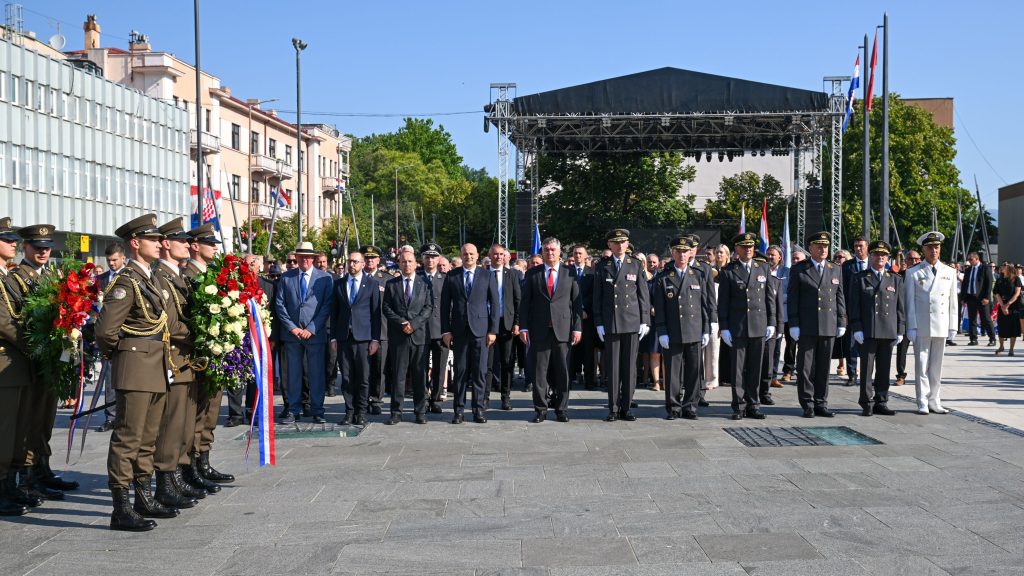
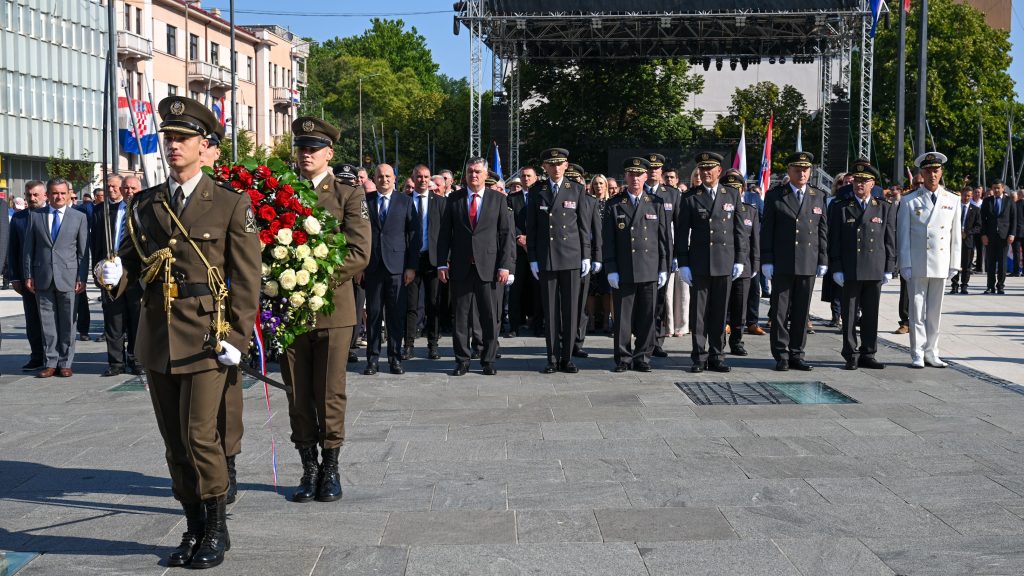
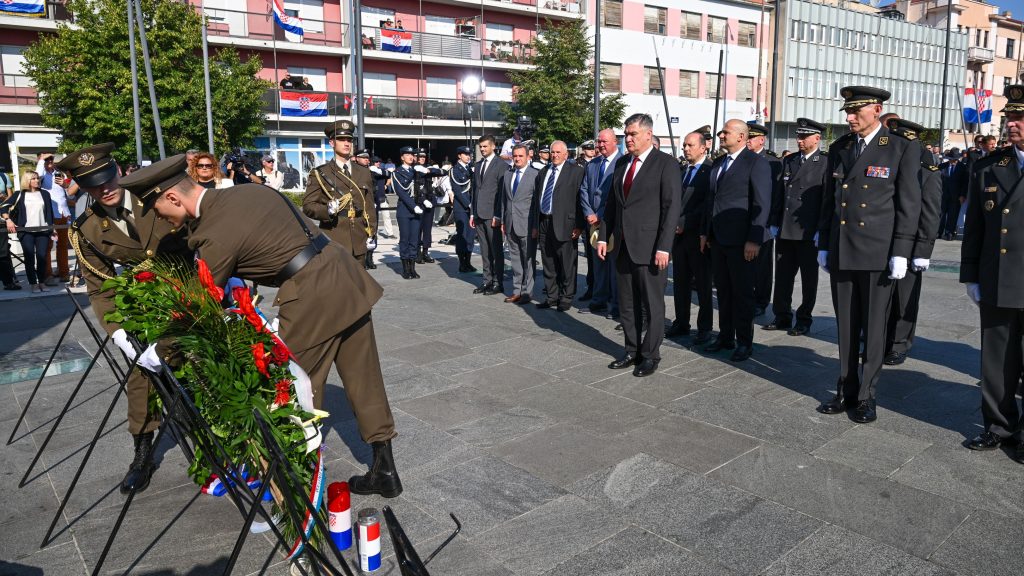
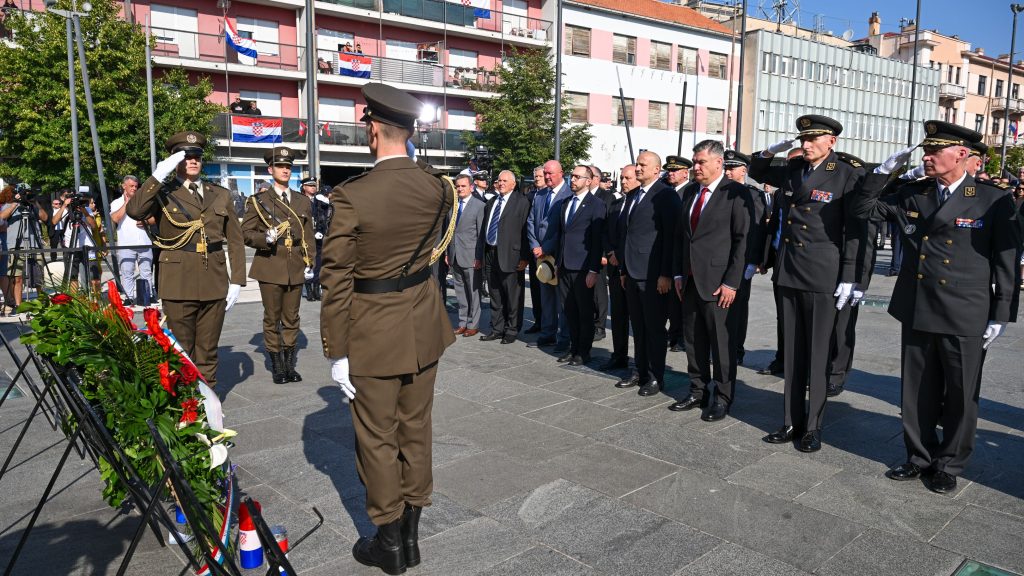
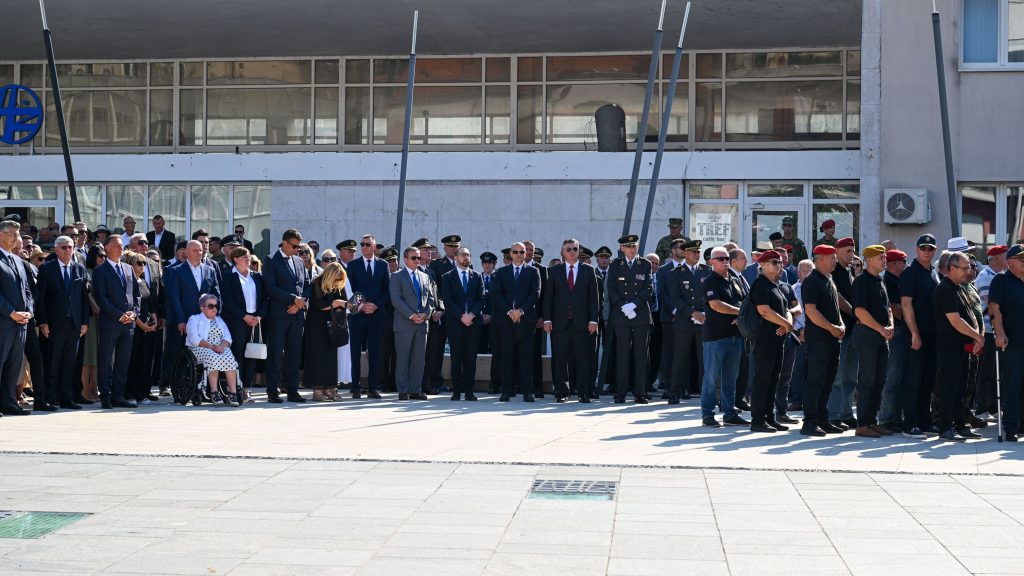
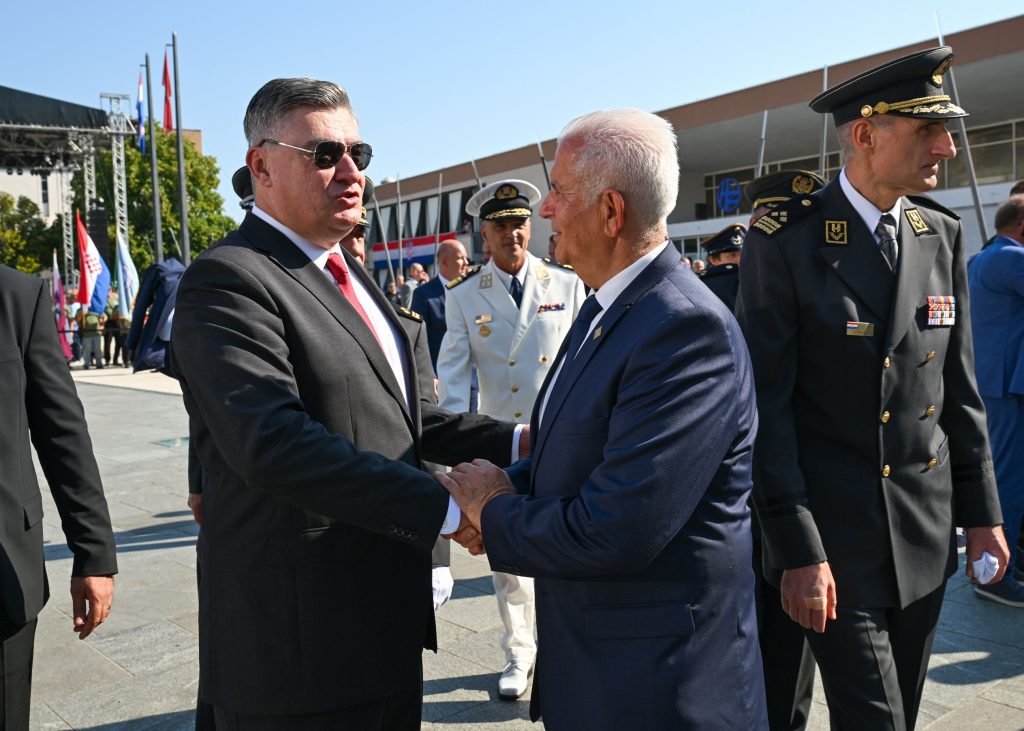
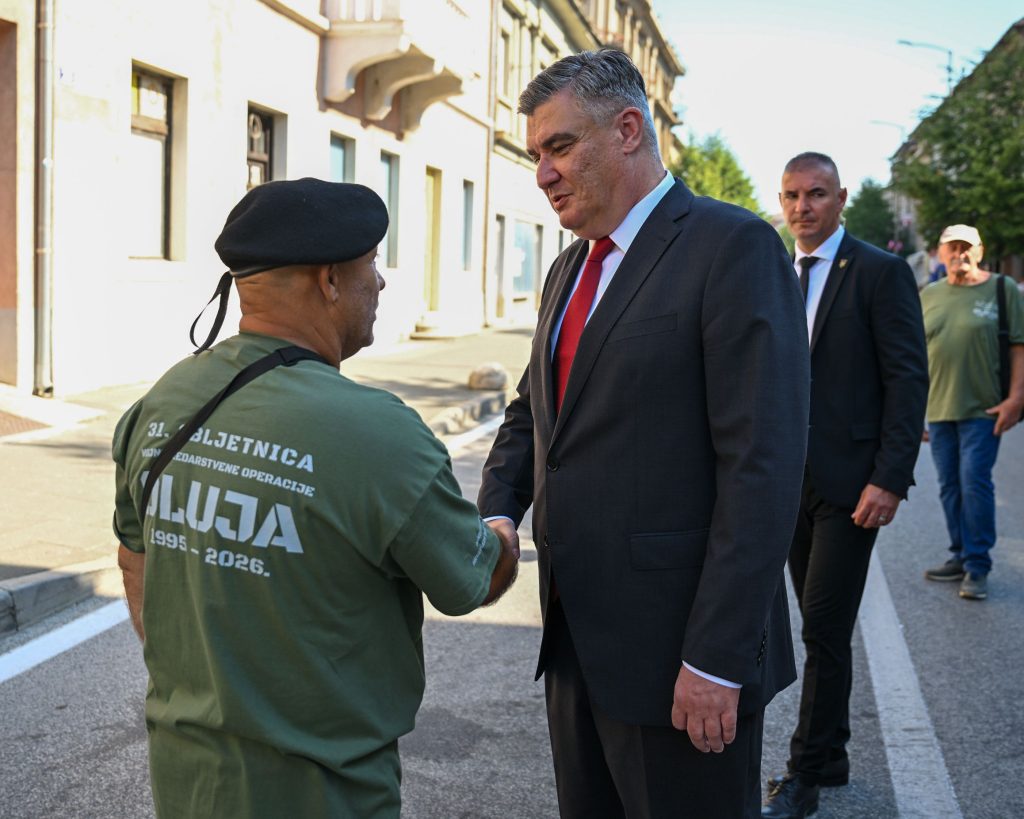
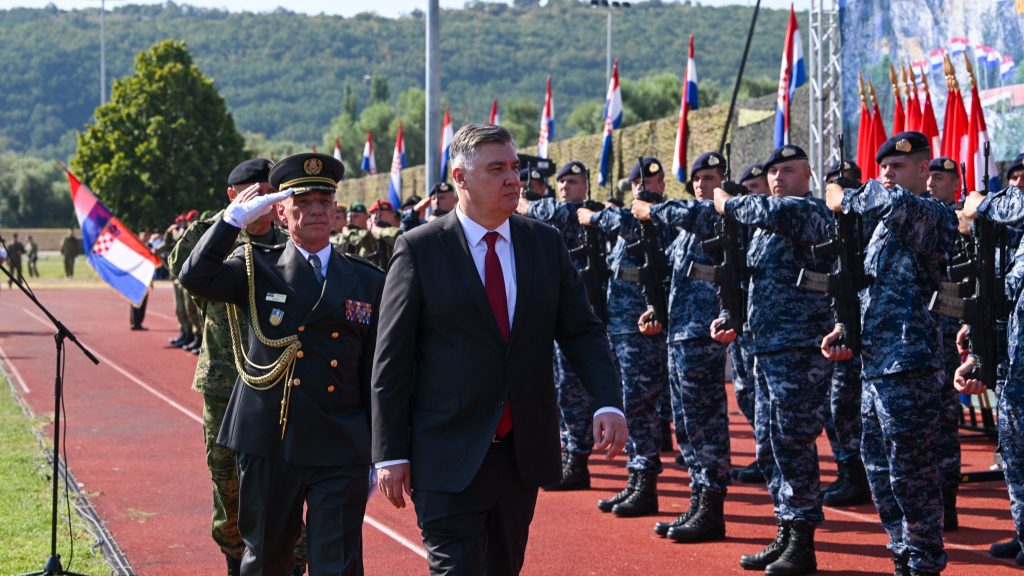
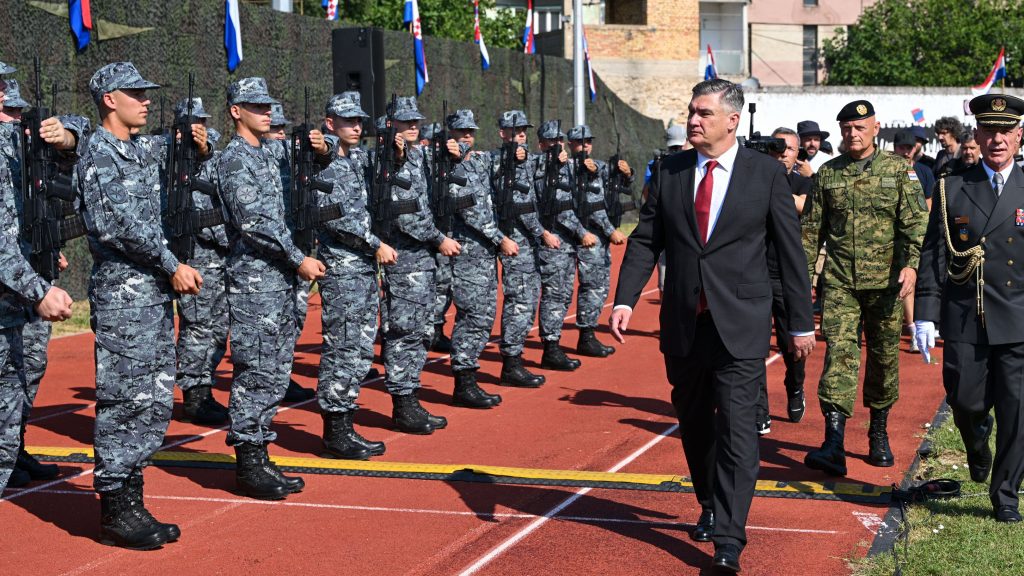
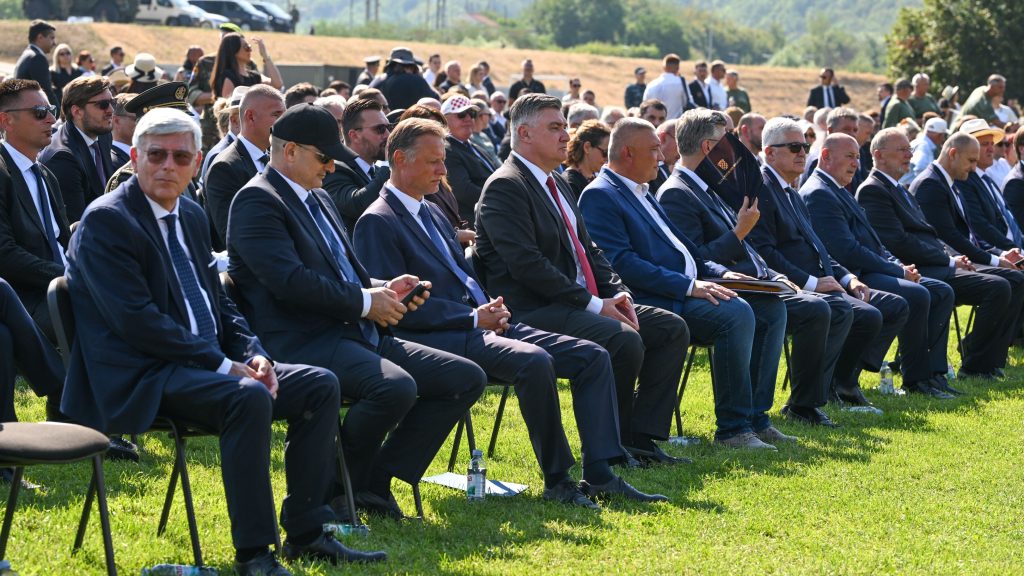
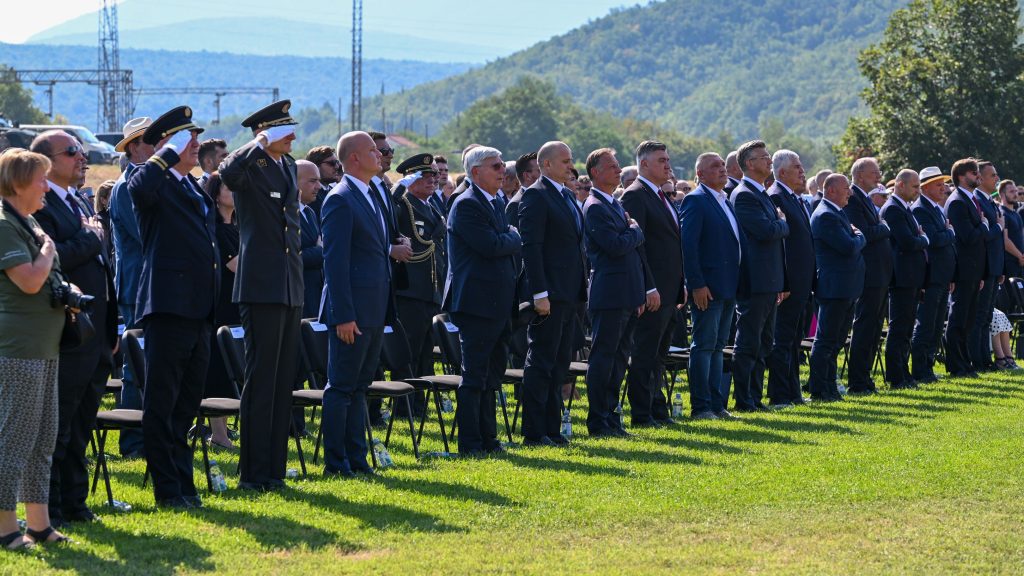
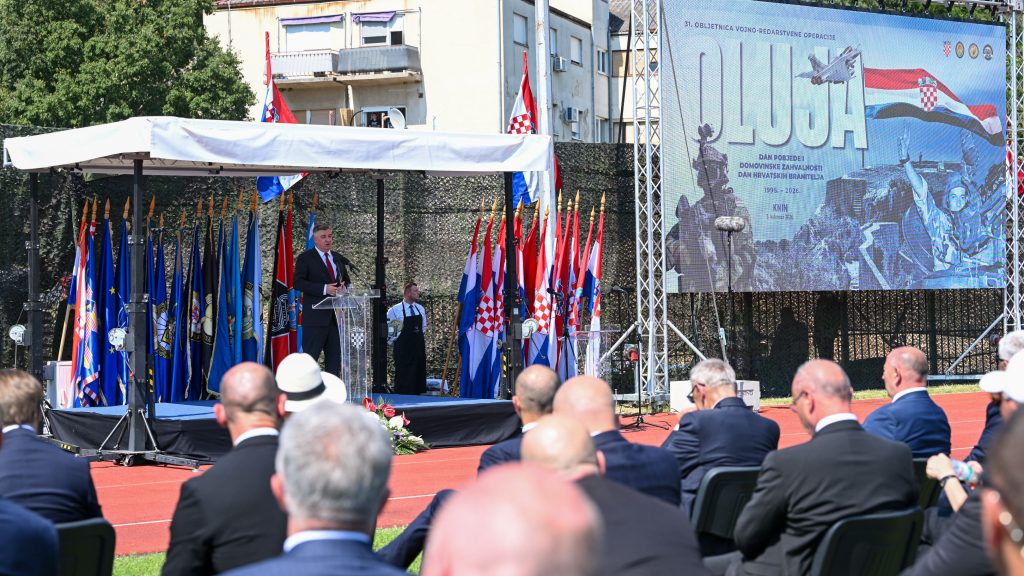
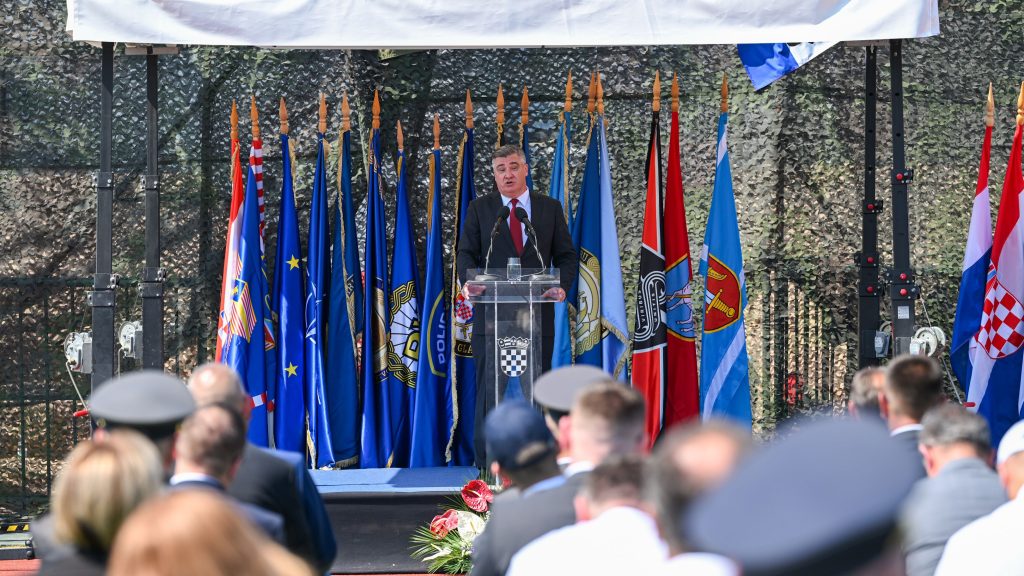
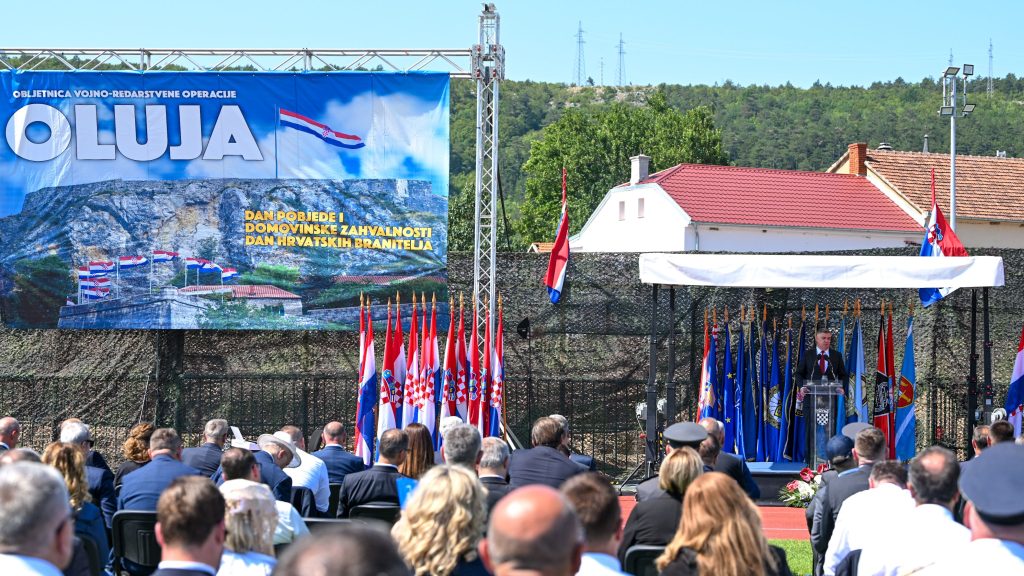
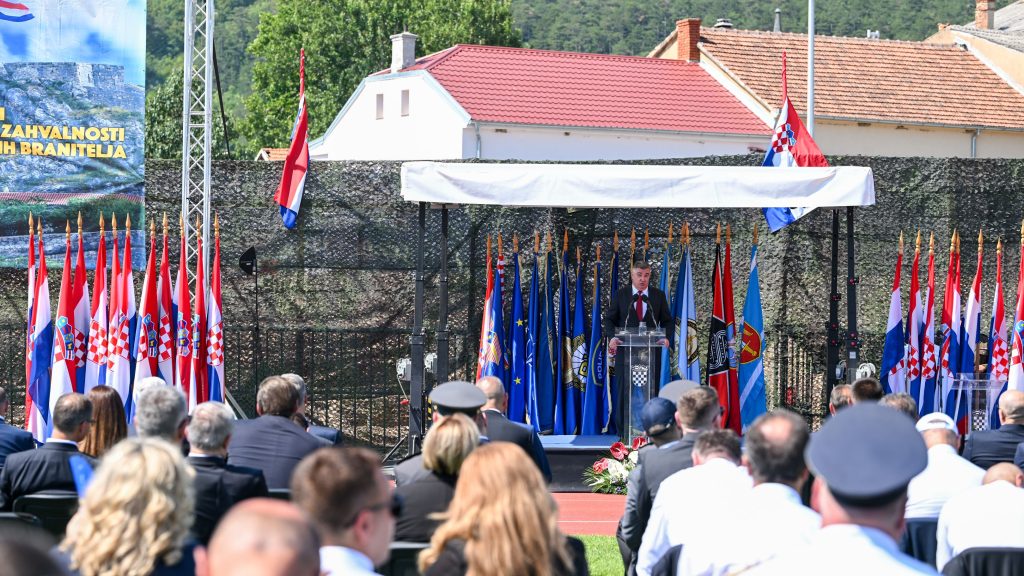
PHOTO: Office of the President of the Republic of Croatia / Ana Marija Katić