President Milanović: The world is on the edge of chaos, Europe can no longer rely on the USA and a cooperation of European states in defence industry necessary
“Today’s world is on the edge of chaos. The situation is bad, and these are not merely challenging times – this is disorder. That is why we must become aware of certain things and take certain steps within the framework in which we are able to act. Of course, we are part of a community, part of the European community that speaks about common defence, which, let me say immediately, is an unrealizable idea as a whole and as a compact system. But cooperation – yes. Absolutely: cooperation among European states, EU member states, in the defence industry and in the development of certain systems – yes. We have generally had good relations with the United States, but things have changed and Europe can no longer rely on that. If it waits, it won’t be good. And that is precisely why Europe, or the larger countries in Europe – and we are not among them – must begin cooperating very concretely on the development of defensive and offensive systems that, for example, Russia possesses and Europe does not. Does Europe have the knowledge, the technology, and the money to develop them? It does, one hundred percent. But for too long it has lived in a world of illusions, reassuring itself that someone else would do it on its behalf,” said the President of the Republic and Commander in Chief of the Croatian Armed Forces Zoran Milanović while commenting the situation in the world at the formal session on the occasion of the marking of the Croatian Army Day, and 35th anniversary of the formation of the Croatian Army.
In his speech, the President warned about the collapse of the international law: “There is more than just war in the Middle East. Russia attacked Ukraine, Russia is an aggressor. We also have aggressors in the Middle East. This has nothing to do with international law. I was raised in the spirit of international law, which is the best friend of small states. And it really is when it is not trampled on and devalued in the way it is being done today. One of the values of the Croatian Constitution is peace-making. These are all topics that we need to talk about more with each other, both as officials and as society as a whole. We are not builders of a great centralized Europe that will be governed by one or two great nations. We are defenders of our state, our national pride, our heritage.”
President Milanović considers that “things are also complicated when it comes to interaction with our immediate environment.” “For instance, the president of a neighbouring country does not give up on intimidating his citizens with the prospect of a Croatian and Albanian attack on Serbia. That would be comical if it were not frivolous and disturbing. People listen to it and when it comes from the head of state, no matter how unreal it seems, they wonder whether it is true. Our Ministry of Defence signed that Declaration of Cooperation. But, we have a much more serious agreement with Serbia that has been in force since 2010. It was ratified by the Croatian Parliament. It is not just a Declaration of Ministries, which is a lower-level international legal document, but it is an agreement. I welcome the Ministries’ document because, after all, it is our right to sign such documents. But, it is not some kind of military alliance directed against any third country. And I know it is inferior to constantly explain the matter, but we are doing it for the sake of our people, and then partly also for the sake of the Serbs, so that they simply understand what their president’s business is about. That’s frivolous,” explained President Milanović.
He considers the behaviour of some allied states to be equally irresponsible. “Equally irresponsible, turning now to our own camp, are the calls and appeals I hear week after week from high-ranking officials of certain Baltic states to attack the Kaliningrad Oblast. That is more than irresponsible. Such things should not be said. We are one of the thirty members of the Alliance, and we are in solidarity, but solidarity must be justified and earned. We are in solidarity on the basis of Article 5 of the Washington Treaty establishing the North Atlantic Alliance, but to what extent? To an absolute extent, such that we have no influence, no insight, and no knowledge of what any of our thirty allies may say? That is quite an unnatural position. And our soldiers are in Lithuania, our equipment is in Lithuania. Therefore, solidarity and readiness to come to someone’s vital assistance on the one hand also presuppose responsibility on the other,” said the President.
Speaking about the formation of the Croatian Army 35 years ago, President Milanović emphasized the uniqueness of Croatia compared to other EU Member States: “Thirty-five years ago, Croatia formed its guard. Croatia was already a state at that time, even though it was not internationally recognized. What Croatia lacked in order to be a complete state, as we see and understand it, were an army and diplomacy. We did not have those. Only an organized society – already a state, and not a randomly assembled group of people – could successfully accomplish such a task. Croatia established an army very quickly. That army operated in impossible conditions, but behind it stood an organized society with clear goals and excellent political leadership that knew what needed to be done, what the threat was, and what the way out was. Everyone thinks they are special, but they are not. Yet in one respect we are special: we are the only country in the European Union that has gone through a war, that was attacked, that had to fight for survival, for identity, practically for life itself. No one else among the nearly thirty of us in the EU has had such an experience. And such an experience shapes you, marks you, defines you, limits you in some respects, but also gives you qualities that are unique. In that sense, we are unique. Others have not gone through that. And when we speak about international peace, about security in our surroundings – and these are things we must discuss – then we have both the right and the duty to be aware of that. Not only because of the debt we owe to the victims of our war, but because it is our experience and our obligation to see things and perhaps assess them better than others.
“The Croatian nation will not disappear within the European Union. And the task of the Croatian Army has been and will continue to be to form part of that way of thinking, emotion and pride carried in the chest: to know what is Croatian and to defend it, without coveting or seeking what belongs to others. Great topics on a great day – the day that created the Croatian Army and showed that the new Croatian state, in the process of emerging in international legal terms – a process completed only a few months after this formation – was in fact already a state at that time, and that it possessed the strength, pride, boldness, and organizational instruments to behave like a state, to violate the international embargo, which was unjust and disgraceful, because that is what nations and armies do when the survival of the nation is at stake,” concludes the President of the Republic Zoran Milanović.
In addition to President Milanović, the formal session on the occasion of the Croatian Army Day, and the 35th anniversary of the establishment of the Croatian Army, held at the Croatian Army Hall “Zvonimir”, was also addressed by the Chief of the General Staff of the Croatian Armed Forces Lieutenant General Tihomir Kundid, Deputy Prime Minister and Minister of Defence Ivan Anušić, Prime Minister Andrej Plenković, and Deputy Speaker of the Croatian Parliament, envoy of the President of the Croatian Parliament and academician Željko Reiner. Awards and incentive measures were presented to members of the Armed Forces of the Republic of Croatia.
President Milanović was accompanied by the Head of the Office of the President of the Republic Orsat Miljenić, Adviser to the President of the Republic for Defence Ivica Olujić, Adviser to the President for Homeland War Veterans Marijan Mareković, and Head of the Military Office at the Cabinet for Defence and National Security, Colonel Franjo Hrala.
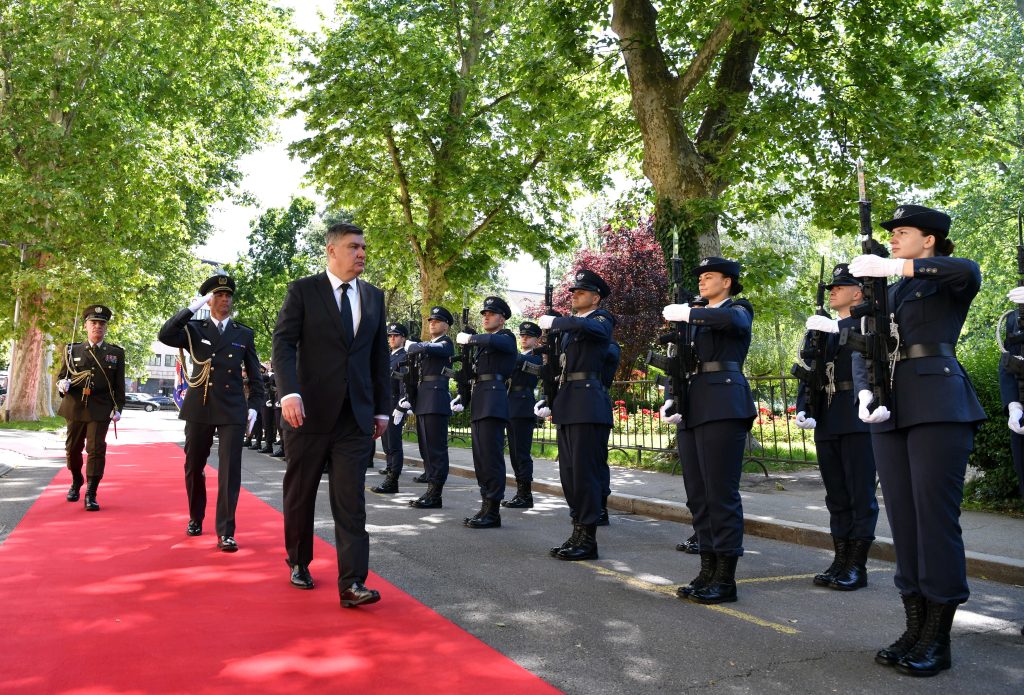
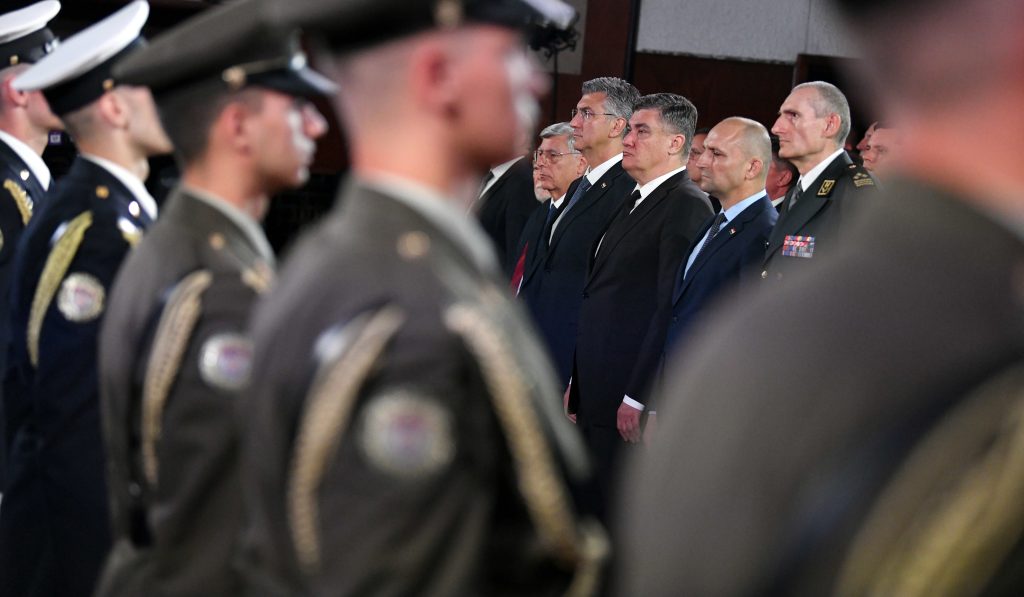
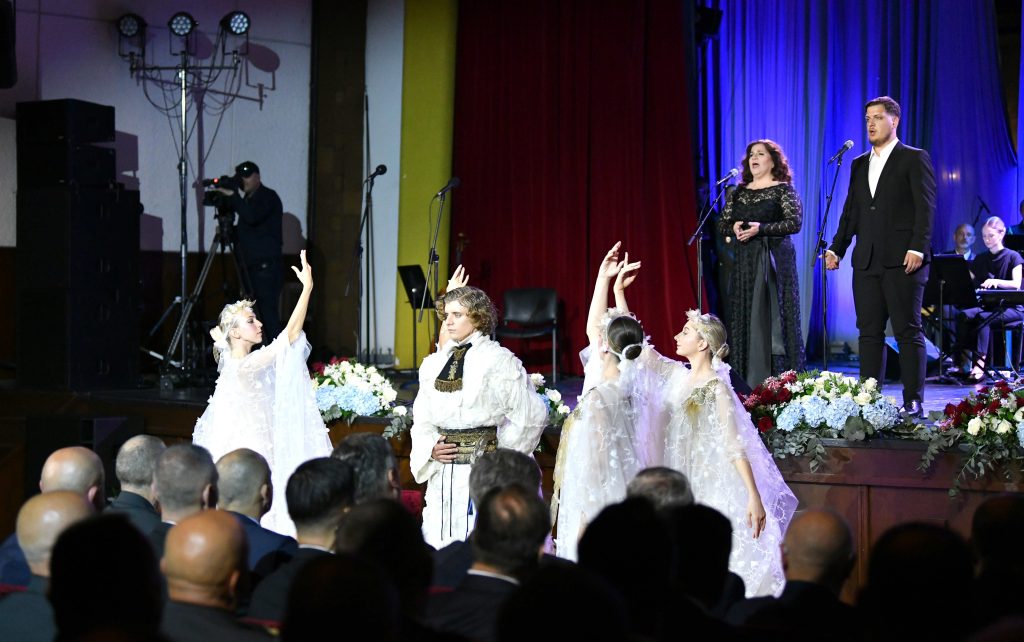
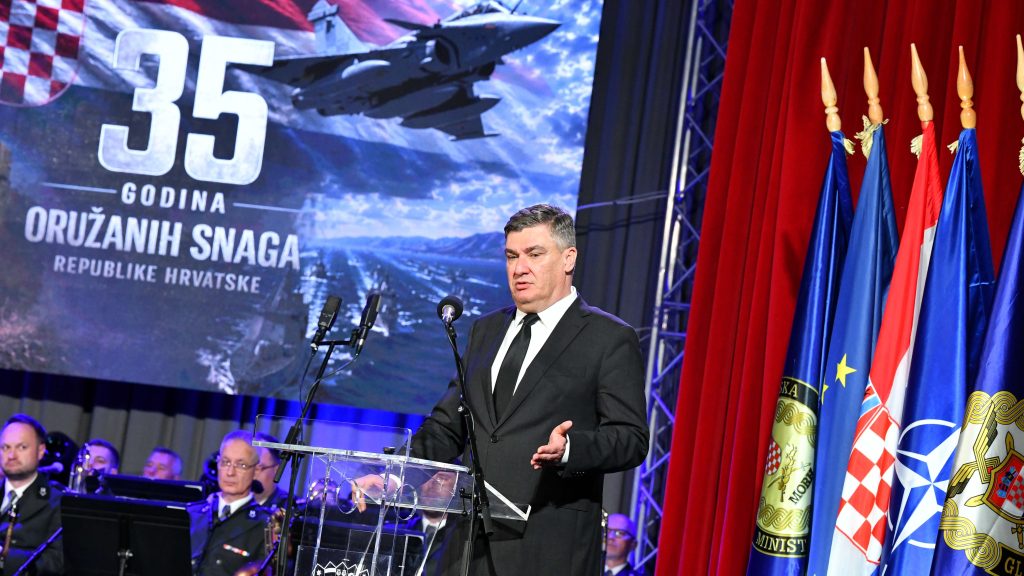
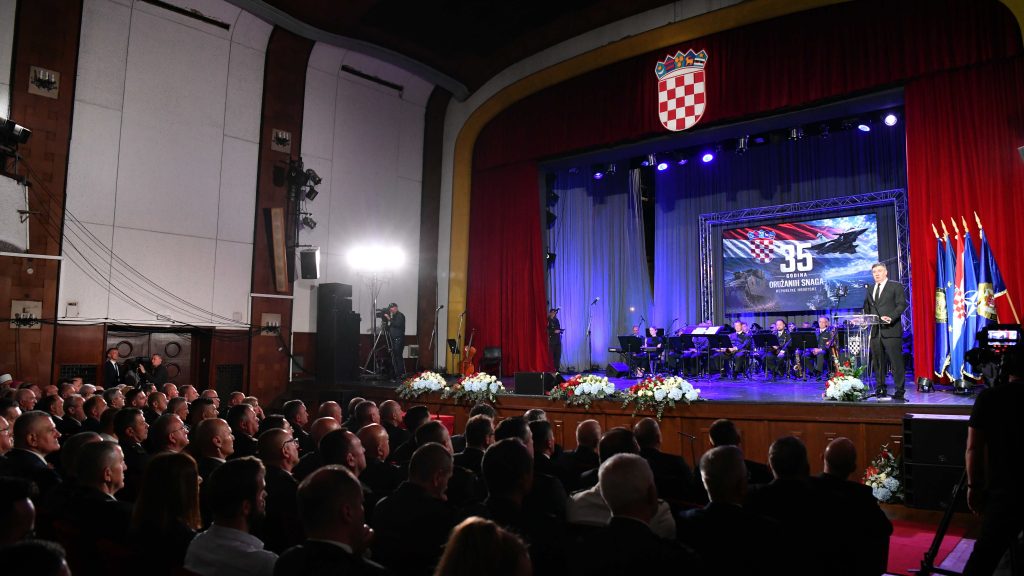
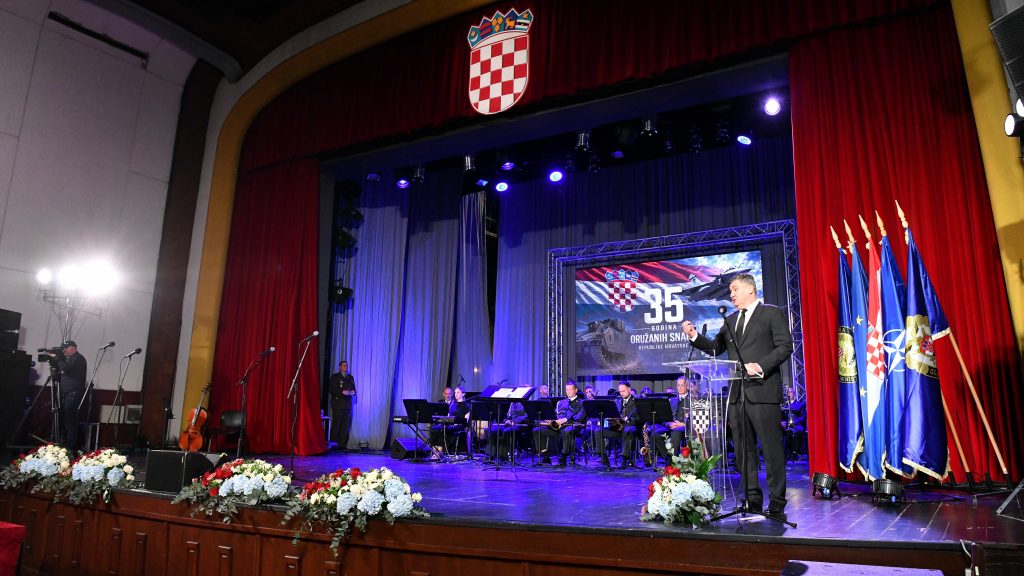
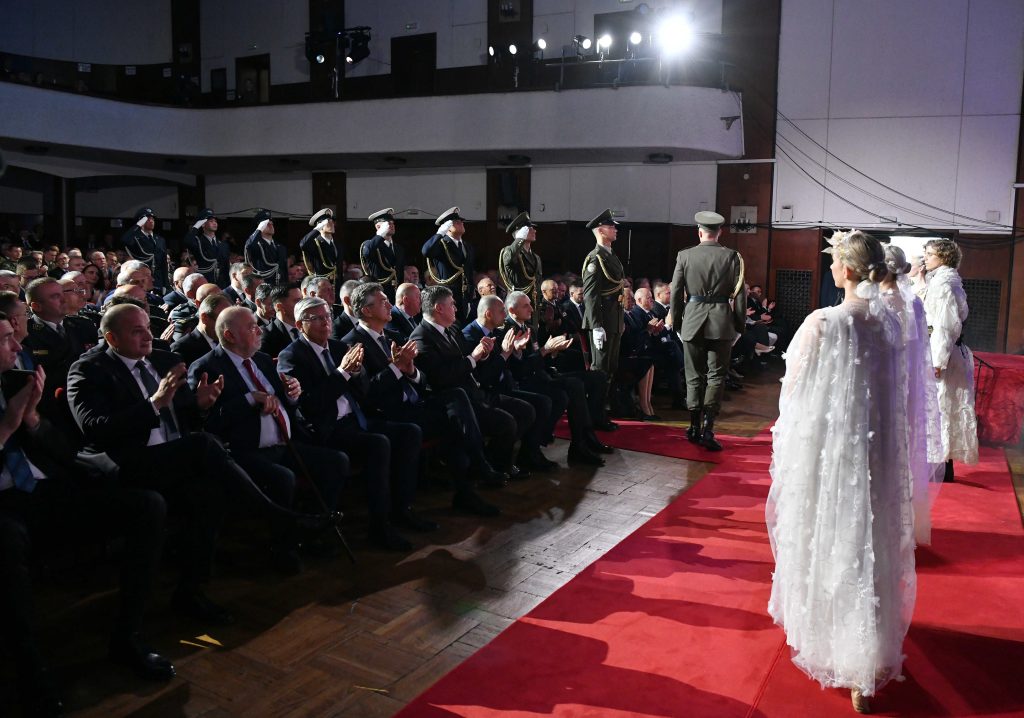
PHOTO: Office of the President of the Republic of Croatia / Tomislav Bušljeta