President Milanović: Anti-Fascist Struggle Day would not exist with Tuđman because he was a part of it as well
The President of the Republic, Zoran Milanović, participated today in the commemoration of the Anti-Fascist Struggle Day on the occasion of the 85th anniversary of the founding of the first partisan detachment and first anti-fascist unit in Croatia and this part of Europe. During the commemoration, the President stated that “without Tuđman, Mesić, Manolić and Boljkovac this public holiday would not exist.”
“It is a miracle that is has been preserved and commemorated to this day,” added President Milanović at the Brezovica Memorial Park near Sisak. “These people were partisans, commissars and members of the Communist Party founded in 1937,” said the President, reminding that Hitler attacked the Soviet Union on 22 June 1941. “With almost four million soldiers, Nazi Germany and its myriad of European allies of the time – of today’s democratic, free and curious Europe, they say – attacked a dictatorship, pushing it onto a fight for bare life. Having heard this news, around 70 communists from Sisak fled in order to avoid getting captured by the Ustasha and Gestapo. This is where a great and epic tale began, in which we tend to leave out some actors, protagonists and producers,” said Milanović.
President Milanović stated that we like to emphasize how these 70 or so communists were Croats, except form Nada Dimić. “Neither was nationality crucial at the time, nor did they identify in such a way. They wouldn’t have made it past the first railway line had there not been for the Croatian Serbs in the Banija and Kordun regions. This needs to be said and repeated a thousand times, because without this synthesis, this whole story would remain an untold one,” emphasized President Milanović, adding how the 70 Sisak communists headed south and “spread the uprising among their Serb brothers and neighbours.” “Had the Ustasha been thicker than two short planks and calmer, the Serbs wouldn’t have risen in rebellion. They saw the collapse of the Yugoslav monarchy as treason and would have been open for a form of collaboration. Back in 1938 during the Kingdom of Yugoslavia, those people and their political representatives were ready for an active and direct partisan cooperation with the then biggest and true Croatian party, Croatian Peasant Party,” reminded the President, adding that this proves that an age-long hatred between Croats and Serbs does not exist.
“Had it not been for those seventy communists, the uprising would’ve come to nothing. And that is a great thing because it has no counterpart in Europe. Today’s European Union, whose member state we are today, cannot represent the synthesis that this National Liberation War represents for the Croatian and Serbian peoples. The European Union also comprises of the states which have also collaborated with Hitler. They were his right hand. They mobilized thousands of young men for the war at the eastern front,” reminded President Milanović, emphasizing that the European Union was conceived as a peace project and “as long as it operates as a peace project in its constitutive points and elements, it is good and right; without that, it is not.”
“The European Union is and is not a successor of the things we witness today. And what we witness today is a celebration of military units named after SS commanders and formations. Today’s Europe calmly and coldly tolerates all of this, pretending as if nothing is happening,” warned the President.
Furthermore, President Milanović emphasized that the Croatian people are sceptical, and that they were the same back in 1941. “By the end of 1941, there were a total of seven to eight thousand people in the partisan detachments, while the Ustasha militia numbered 11 to 12 thousand people. That is very few people when you do the math. The remaining population was sceptical. They did not weep for the collapsed kingdom, but the people and the citizens were sceptical and looked with anxiety at what was to come. I think this trait is still the most useful today for Croats and for any nation. However, we must speak openly about the things that happened in the past. That is the only remedy for these neuroses overtaking Europe,” President Milanović explained.
In his address, the President also reflected on the commemoration of the Zagreb Liberation Day on 8 May and the Trnje Bonfires [Trnjanski kresovi] event, during which one group of citizens gathered to commemorate it, while another group protested against the commemoration. The President of the Republic stated that this is not good because commemoration is a civil right, and the guarantors of that right are the people whose monuments stand only 400 meters from the gathering site. “Those are the monuments to Veljko Holjevac and Franjo Tuđman. These two Croatian partisans and commissars were the great men of that era. Let us not act this way, because we will get lost and we will lose any moral compass. This is our history, these are our national heroes. Our first wartime president, Franjo Tuđman, was fully a part of that group, and he was a part of that synthesis. We cannot see past thit,” the President emphasized.
“Croatian history is also about scepticism. And a part of the Croatian reality is that we cannot and will never be able to reach a full scope agreement on this date, as well as that we will think differently, and think within the framework of our own Croatian acumen and space. We must be aware that this was what Tuđman, Hebrang, Bobetko, Cvetković, Mika Špiljak, Ivan Šibl, and Vlado Janjić Capo ultimately fought for, and that in 1991, Croatian freedom and dignity were defended by some other people, who are much better known and closer to us. And as such, we cannot and should not be identical, like a uniformed, ideal-typical European figure of a model citizen. Such a thing does not exist. Portugal, Finland, Croatia, and Slovenia are countries of this area. We differ so much that it is impossible to turn us into a single state. And we must not, because that is a path to ruin. We must retain our identity; we must retain our rights in the modern sense; we must not allow ourselves to be dragged into other people’s quarrels. We must look after our own interest, and be selfish in managing our affairs – but not wicked, disloyal, or hostile toward others. We must look after ourselves. That is the Croatian imperative,” President Milanović pointed out.
President Milanović warned that divisions in Croatia today are even greater than twenty or so years ago. “I was there in Bleiburg in 2008 thinking: that’s it, the story is over. Everything is the same, and it’s even worse than in 2008. Tuđman was never in Bleiburg, and he relativized it in his interviews, pretending that it had never happened. Tito was never in Jasenovac because, however aware he was of the Ustasha crimes, he was also aware that it was an exaggeration within the framework of the current politics at the time. These are the signs of reason that we see in our predecessors, in people who were not free of controversies, but possessed a certain statesmanship substance and posture, who were not by accident recognized, accepted, and challenged by so many people. Because, in a boat, those who make trouble are the ones who don’t row; those who row don’t have time for that. Therefore, let’s row together,” President Milanović concluded, greeting those present with the words: “Dignity to the Croatian people and to all the nations around us.”
In addition to the President of the Republic, other speakers at the commemoration of the Anti-Fascist Struggle Day included the President of the Alliance of Anti-Fascist Fighters and Anti-Fascists of the Republic of Croatia Franjo Habulin; the Envoy of the Prime Minister of the Republic of Croatia and Minister of Labour, Pension System, Family, and Social Policy Alen Ružić; and the Envoy of the Speaker of the Croatian Parliament and Chairwoman of the Education, Science and Culture Committee of the Croatian Parliament Vesna Bedeković.
Ahead of the ceremony at the monument to the First Partisan Detachment in the Brezovica Memorial Park, President Milanović and his delegation, envoys of the Croatian Parliament and the Government of the Republic of Croatia, the Prefect of Sisak-Moslavina County Ivan Celjak, the Mayor of the Town of Sisak Domagoj Orlić, and the President of the Alliance of Anti-Fascist Fighters and Anti-Fascists of the Republic of Croatia Franjo Habulin laid a flower in honour of the beginning of the National Liberation War. Accompanying President Milanović were the Head of the Office of the President of the Republic Orsat Miljenić, the Adviser to the President for Human Rights and Civil Society Melita Mulić, and the Special Adviser to the President for the Economy Velibor Mačkić.
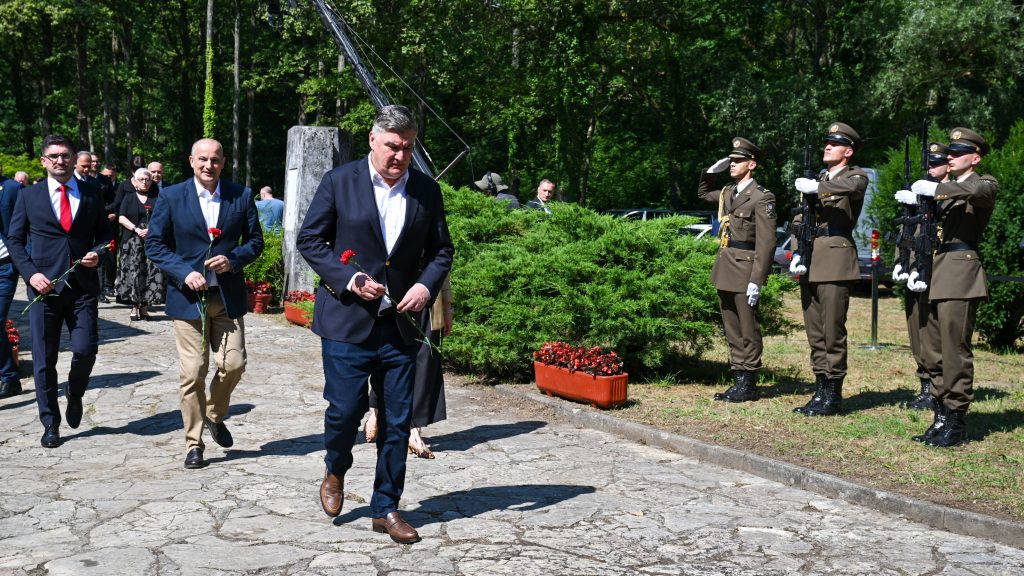
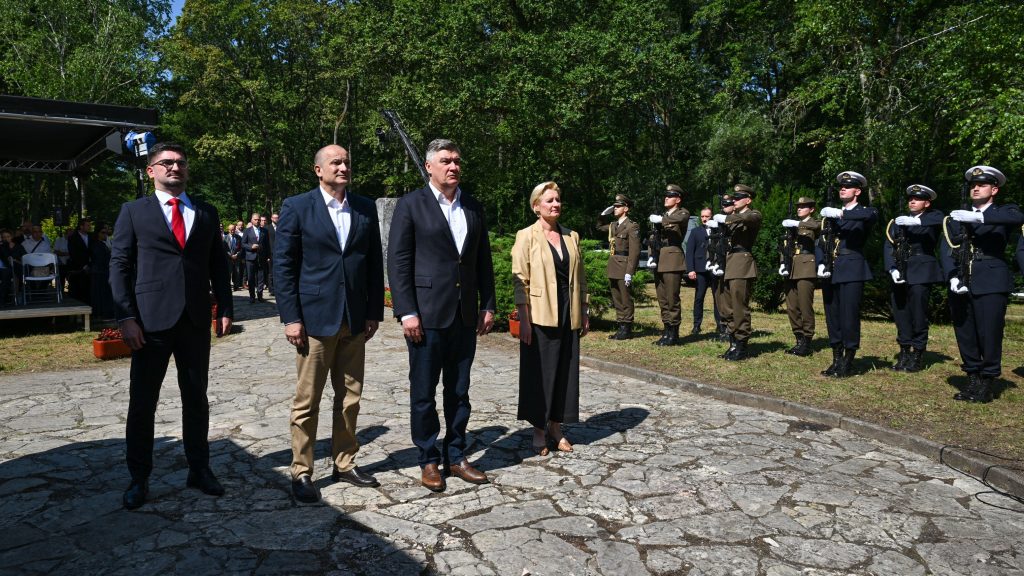
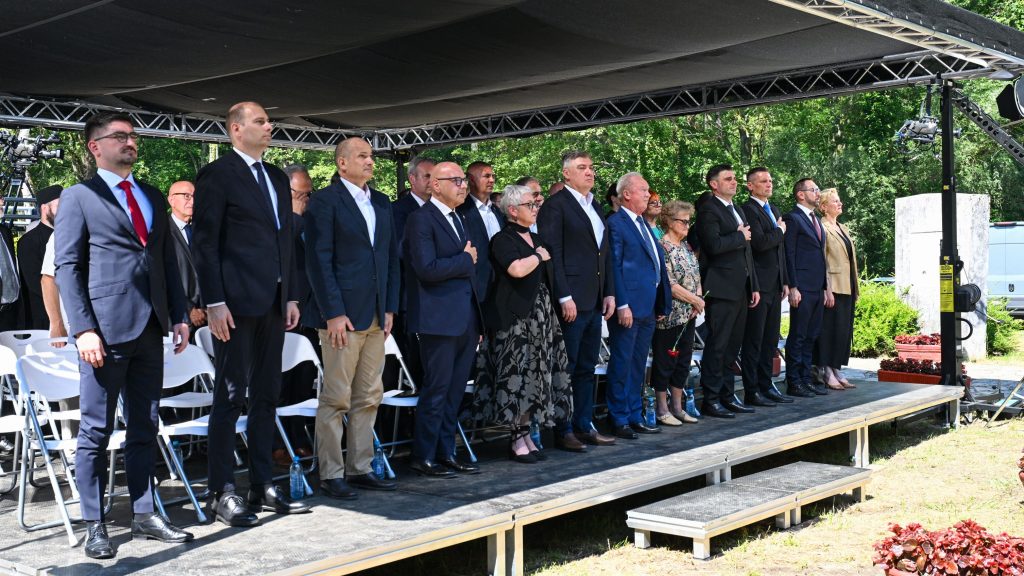
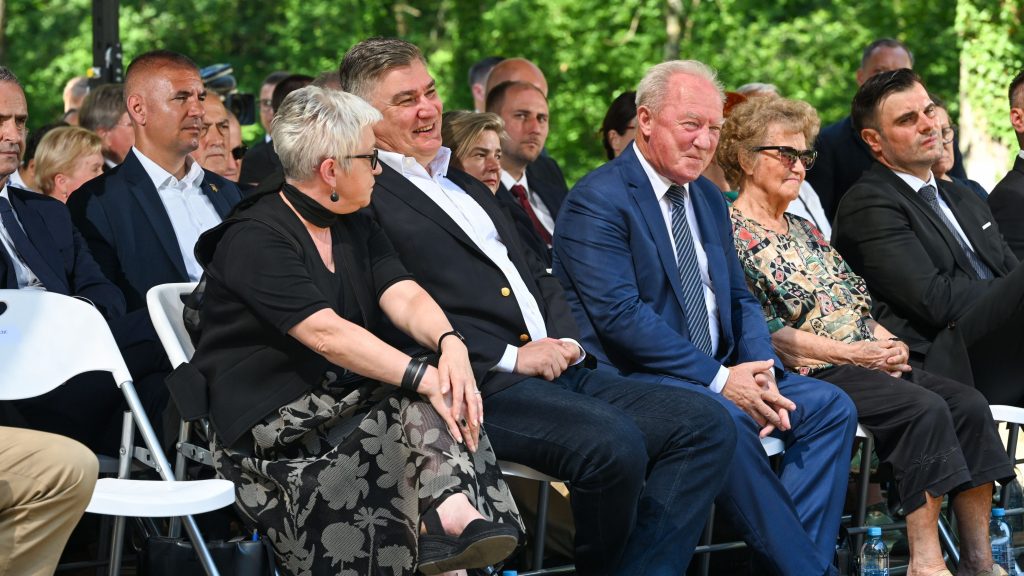
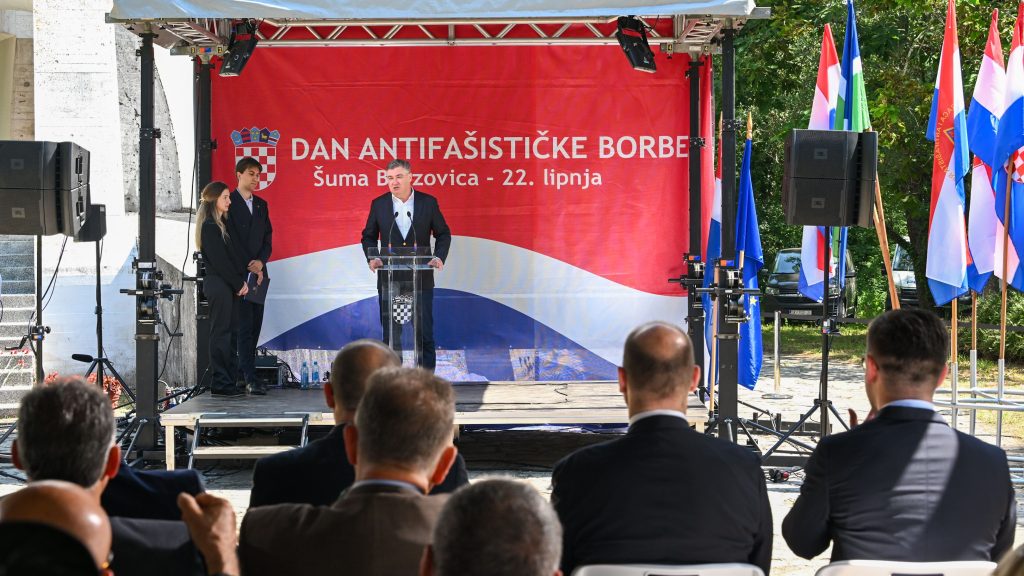
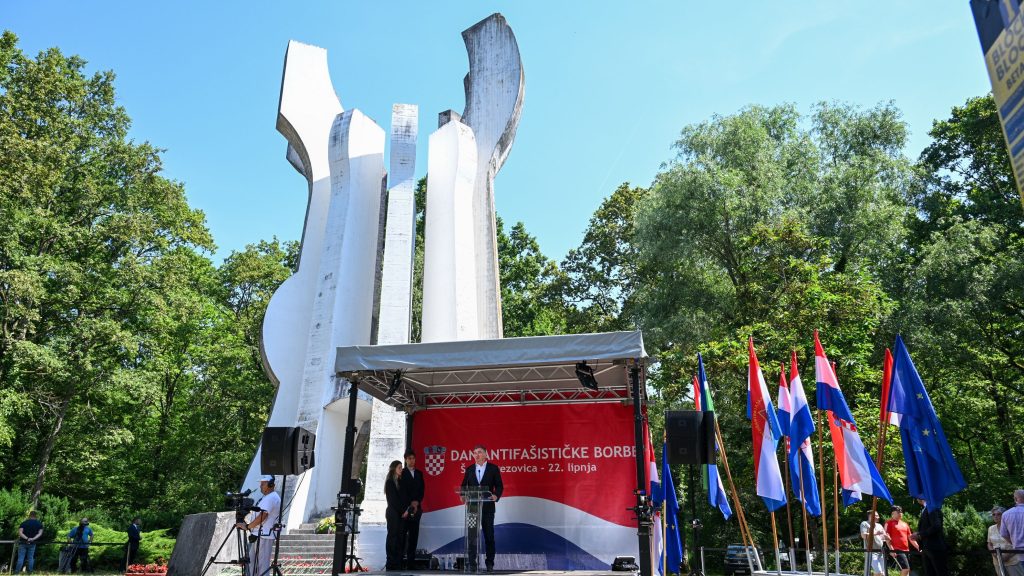
PHOTO: Office of the President of the Republic of Croatia / Ana Marija Katić